A Custom Inground Pool Built Around Your Backyard
A custom inground pool is designed for your yard, your budget, and the way you want to use it. You can choose a clean geometric look or a natural shape, then plan features such as a spa, sun shelf, or water feature. Unlike a fixed package, the design can account for your lot and how your family wants to swim, relax, and gather.
If you’re planning a pool in Cape Coral, start with your must-haves and a clear budget. Ask for a detailed design and written estimate before construction begins. Proline Pools brings more than 25 years of Southwest Florida experience, hands-on owner supervision, and a focus on reliable pricing to that process.
Why Invest in a Custom Inground Pool Over a Standard Package?
When you decide to build a swimming pool, you quickly face a choice: choose a cookie-cutter catalog package or create a tailor-made outdoor space from scratch. While pre-set packages might seem simple, they rarely account for the unique layout of your property, your architectural taste, or the specific ways you plan to spend time outdoors.
Opting for custom construction ensures complete harmony between your home’s architecture, your property boundaries, and your daily lifestyle.
- Lot Optimization: Every backyard in Southwest Florida presents unique dimensions, setback requirements, utility lines, and sun exposure angles. A personalized plan maximizes every square foot, working around existing trees, lanai structures, or canal views without wasting usable yard space.
- Tailored Aesthetics: Rather than settling for a standard blue rectangle, you can select custom waterline tiles, natural stone coping, artistic interior finishes, and integrated deck materials that seamlessly match your home’s exterior palette.
- Structural Durability: Custom builds are engineered on-site to handle regional soil conditions and local groundwater levels, using heavy-duty structural steel reinforcement and high-strength concrete.
- Seamless Outdoor Living: A custom layout integrates directly with surrounding elements, such as covered lanais, outdoor kitchens, fire lounges, and screened enclosures, turning your backyard into a unified private resort.
Popular Custom Inground Pool Design Styles and Layouts
Every custom pool begins with a foundational shape. Because a custom build is engineered from scratch, your pool can take virtually any form that complements your landscape.
- Geometric Pools: Defined by clean, sharp lines, 90-degree angles, and crisp symmetry, geometric layouts suit modern and transitional home architecture. Rectangular and Grecian designs remain timeless classics that provide ample unobstructed swimming room.
- Freeform Shapes: Featuring organic, flowing curves, freeform pools mimic natural lagoons. These designs integrate beautifully with lush tropical landscaping, rock waterfalls, and winding garden paths.
- Infinity (Negative) Edges: Designed to produce a visual effect where water vanishes over the horizon, infinity edges are ideal for waterfront lots, golf course views, or properties with slight elevation changes.
- Lap Pools: Long, narrow, and streamlined, lap pools are built specifically for fitness, physical therapy, and daily low-impact exercise, making them an excellent choice for compact or narrow side yards.
- Plunge Pools: Compact yet deep, plunge pools offer a cooling retreat for smaller properties, patio courtyards, or homeowners who desire a low-maintenance water feature focused on relaxation rather than swimming laps.
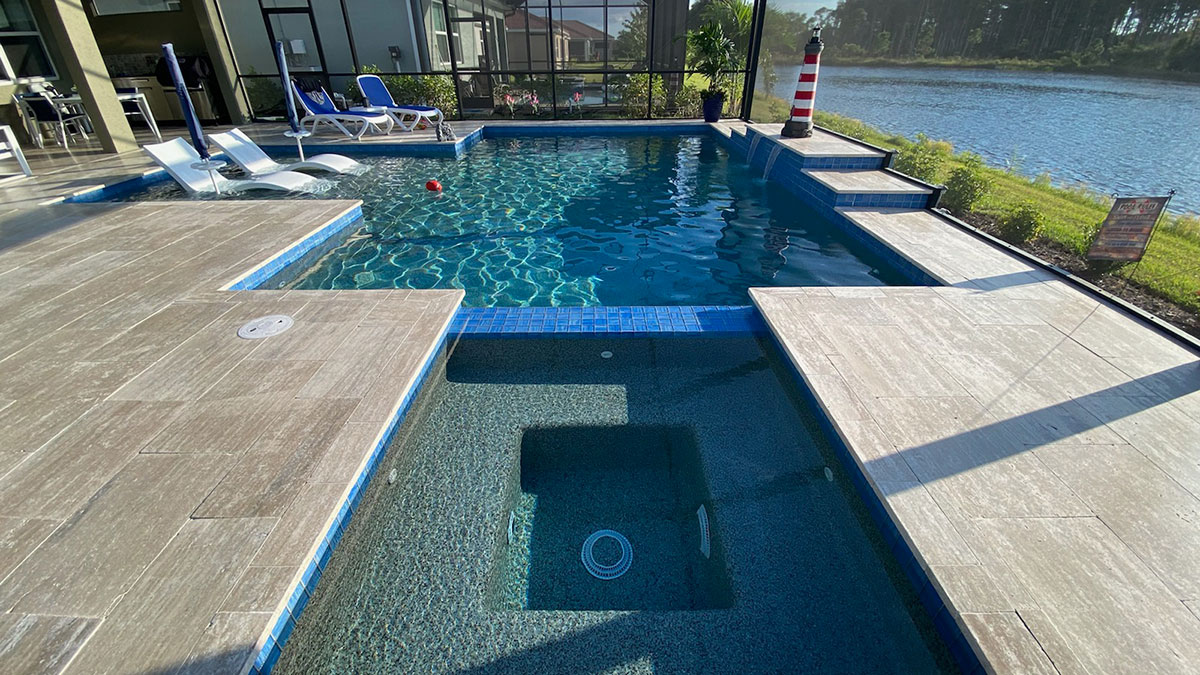
Upscale Water Features and Outdoor Living Additions
Customization extends far beyond the shape of the pool shell. Selecting dynamic water and fire accents allows you to elevate both the visual impact and ambient sound of your outdoor living area.
- Sheer Descents: Smooth, glass-like sheets of water that cascade gracefully from a raised bond beam or feature wall into the pool below.
- Deck Jets and Laminars: Arcing streams of clear water projected from the pool deck directly into the swimming area, often equipped with integrated LED lighting for nighttime entertainment.
- Grottos and Rock Waterfalls: Handcrafted natural stone formations that introduce the relaxing sound of falling water while creating shaded hideaways.
- Bubblers and Foam Jets: Flush-mounted nozzles placed in shallow sun shelves that bubble upward, providing interactive water play for young children.
- Fire Bowls and Fire-and-Water Elements: Copper, concrete, or stone vessels that blend burning flames with flowing water to create an alluring nighttime focal point.
- Sun Shelves (Baja Ledges): Shallow ledges (typically 6 to 9 inches deep) that accommodate in-pool lounge chairs and umbrellas, creating the perfect space for sunbathing or shallow wading.
- Integrated Spas: Raised or flush-mounted custom spas with hydrotherapy jets, custom spillways, and independent temperature controls for year-round soaking.
Gunite Construction and Interior Finish Options
The core structural material of your pool determines its strength, design possibilities, and longevity. In high-end custom pool construction, pneumatically applied concrete—commonly referred to as gunite or shotcrete—serves as the industry benchmark.
Gunite is applied on-site over a comprehensive framework of steel rebar. Because it is sprayed under high pressure without requiring pre-fabricated molds, it allows for infinite architectural shapes, custom depths, built-in benches, multi-level tanning ledges, and intricate steps. When properly engineered and maintained, a gunite structural shell boasts an impressive lifespan of 30 to 50 years.
Once the structural shell cures, an interior finish is applied to seal the structure and define the water’s color and texture:
- Traditional Plaster: A smooth blend of white Portland cement and marble dust that creates a classic light blue water hue. While cost-effective, standard plaster is more susceptible to chemical wear over time.
- Quartz Plaster: Enhanced with crushed quartz aggregate and polymer-modified cement, quartz finishes provide superior stain resistance, extended durability, and a light-reflective, shimmering surface.
- Pebble Finishes: Incorporating smooth, tumbled river stones or imported pebbles embedded in fortified cement, pebble interiors replicate the organic look of a natural stream bed. They offer outstanding longevity, resist chemical imbalances, and provide a textured, slip-resistant surface.
- Glass Tile Elements: Hand-laid glass bead blends or accent tiles bring brilliant sparkle, vibrant color depth, and unmatched luxury to waterlines, steps, and interior walls.
| Construction Method & Finish | Average Expected Lifespan | Design Flexibility | Surface Texture | Key Advantages |
|---|---|---|---|---|
| Gunite Structural Shell | 30–50+ Years | Unlimited | Structural Shell Base | Engineered on-site, solid steel rebar reinforcement, high structural integrity |
| Standard White Plaster | 5–10 Years | Standard Shapes | Smooth | Traditional look, lowest initial investment |
| Modified Quartz Finish | 10–15 Years | Any Custom Design | Smooth with subtle texture | Enhanced stain resistance, reflective color options, strong value |
| Aggregate Pebble Finish | 15–20+ Years | Any Custom Design | Lightly textured / slip-resistant | Exceptional chemical resistance, organic aesthetic, maximum durability |
| All-Glass Bead / Tile | 20+ Years | Custom Surfaces | Ultra-smooth / crystalline | Unrivaled visual depth, zero water absorption, highest luxury appeal |
The Custom Pool Construction Process and Timeline
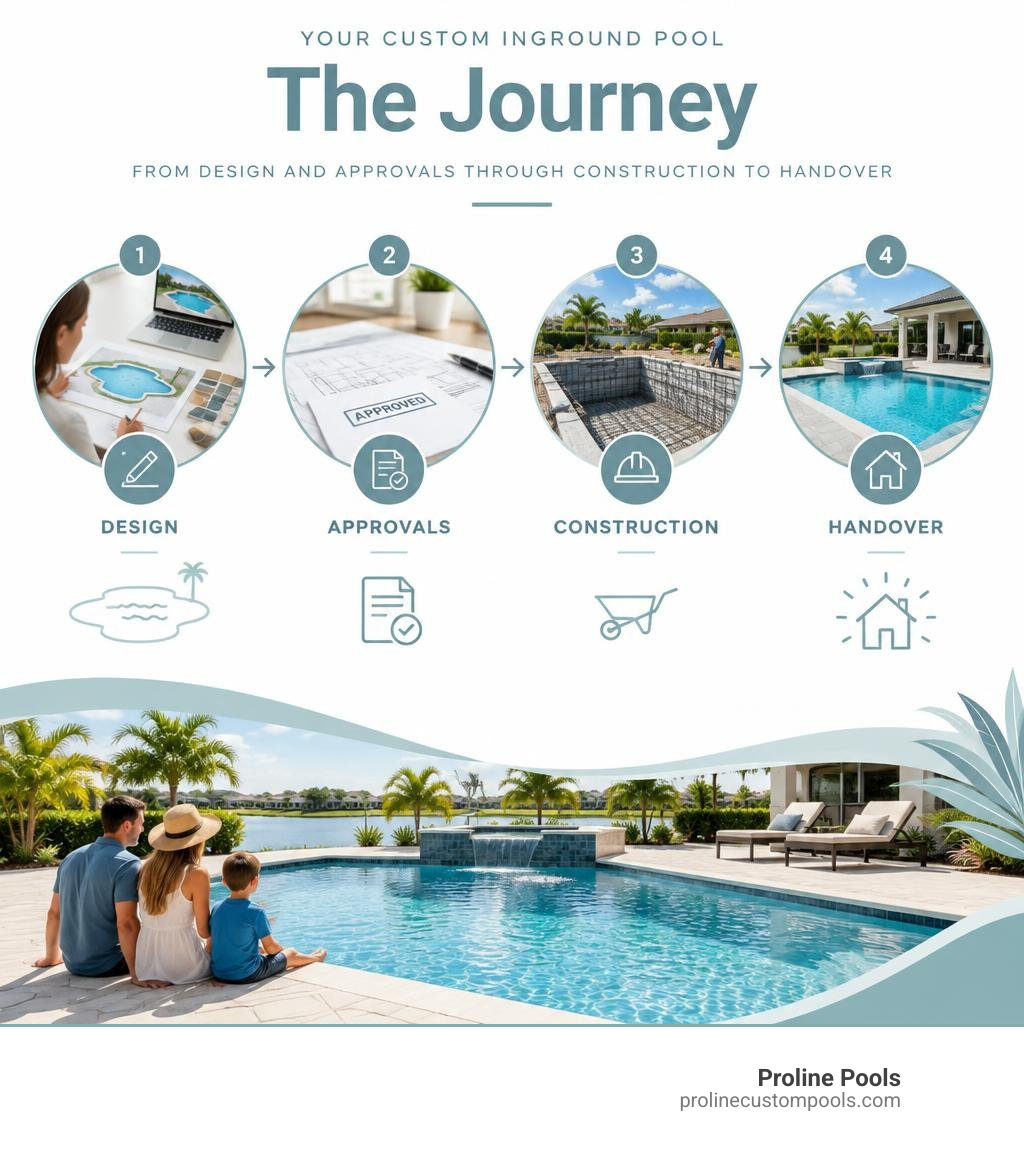
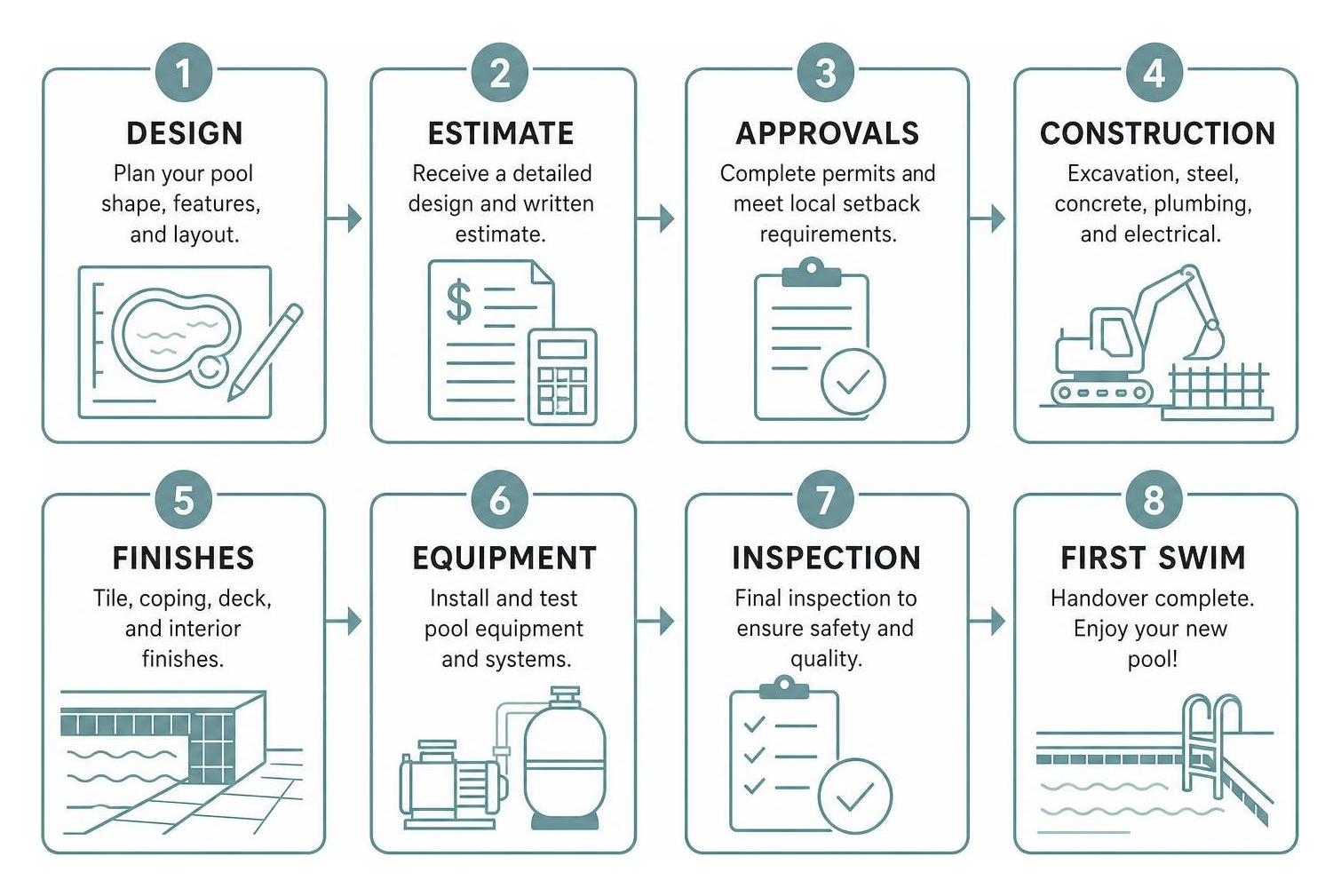
Building a custom pool is a detailed engineering and artistic endeavor. While timeline variations can occur due to municipal review periods, local soil conditions, and summer rainfall, a typical project advances from permit issuance to final orientation in roughly 8 to 14 weeks.
- Design Consultation and 3D Modeling: We sit down with you to explore your ideas, take yard measurements, and examine site conditions. We then build an interactive 3D digital model showing how the pool, decking, landscaping, and water features will integrate with your home.
- Permits and HOA Submissions: Detailed engineering plans are drafted and submitted to municipal building departments and community architectural review boards to secure all mandatory zoning, structural, and electrical permits.
- Site Layout and Excavation: Heavy equipment marks the precision perimeter and digs the pool cavity according to the exact depth profiles specified in the engineering plan.
- Steel Reinforcement and In-Ground Plumbing: A rigid grid of structural steel rebar is placed throughout the excavation. Dedicated plumbing lines, main drains, skimmers, returns, jet lines, and water feature pipes are installed and pressure-tested.
- Gunite Application: Experienced technicians pneumatically apply the high-strength concrete mixture across the rebar cage, hand-sculpting the pool walls, coves, tanning ledges, and steps.
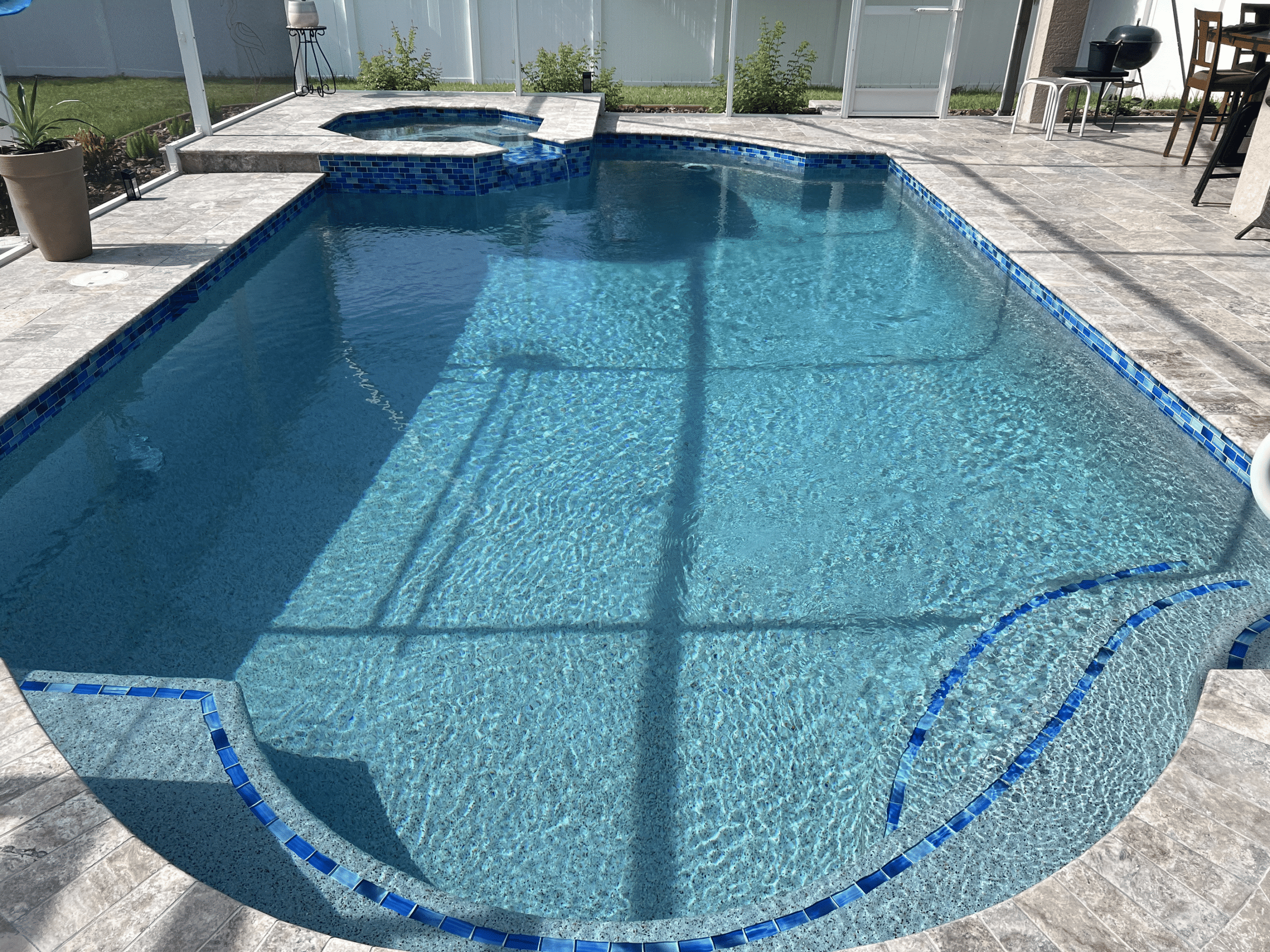
- Tile, Coping, and Deck Installation: Skilled masons install your selected perimeter waterline tile, hand-cut stone coping, and expansive patio decking (such as natural travertine or artistic pavers).
- Interior Finish Application and Filling: The pool interior is carefully hand-troweled with your chosen quartz or pebble finish, followed immediately by filling the pool with fresh water to allow the surface to cure evenly under balanced pressure.
- Equipment Startup, Water Balancing, and Orientation: Pumps, commercial-grade filtration systems, sanitizers, and smart automation modules are activated. We balance the water chemistry and conduct a walk-through to teach you how to monitor and control your new pool.
How Much Does a Custom Inground Pool Cost?
Because every custom swimming pool is designed from scratch, pricing is based on size, structural engineering requirements, site access, material selections, and auxiliary outdoor features. Rather than a flat, one-size-fits-all price tag, custom pools fall into distinct tiers:
- Designer Series ($60,000 – $80,000): Typically ranging from 250 to 400 square feet, these pools feature high-quality gunite construction, clean geometric or gentle freeform styling, a quartz interior finish, energy-efficient filtration equipment, and standard paver decking.
- Luxury Series ($80,000 – $200,000): Ranging from 400 to 700 square feet, this tier incorporates elevated features such as integrated raised spas, custom travertine decking, expanded tanning ledges, pebble interior finishes, dynamic LED lighting, deck jets, and automated smart-phone controls.
- Estate Series ($200,000+): Exceeding 700 square feet, estate builds represent complete outdoor transformations. These projects frequently incorporate complex infinity edges, custom sunken fire lounges, multi-tier rock grottos, swim-up bars, high-end automated sanitation, expansive outdoor kitchens, and custom masonry.
Several project-specific variables influence your final investment:
- Excavation & Ground Conditions: Difficult soil, underground rock, tight lot access, or high water tables require specialized equipment and engineering solutions.
- Surface Materials: Upgrading from standard concrete pavers to natural unfilled travertine, or moving from standard plaster to an imported pebble aggregate finish, adjusts the material investment.
- Water Features & Hydraulics: Adding multiple waterfalls, sheer descents, bubblers, and deck jets requires additional plumbing runs, valves, and dedicated auxiliary pumps.
- Smart Pool Automation: Variable-speed pumps, automated chemical feeders, heat pumps, and mobile app-controlled lighting packages introduce upfront cost while reducing ongoing utility bills.
For a broader look at planning your pool investment, review this Swimming Pool Buyer’s Guide.
Critical Credentials When Choosing a Custom Inground Pool Builder
Your swimming pool is a major enhancement to your property, so selecting the right contractor is essential for a smooth project.
- State Licensing and Active Registration: Verify that your builder holds an active Florida Certified Pool/Spa Contractor license. This confirms they have demonstrated trade competency and meet rigorous state standards.
- Professional Affiliations: Seek out builders aligned with respected trade groups like the Pool & Hot Tub Alliance (PHTA), which uphold high standards for continuing education and construction practices.
- Hands-On Management: Look for a builder who provides dedicated, hands-on supervision on the job site rather than passing your project between disconnected third-party crews.
- Comprehensive Insurance Coverage: Ensure the contractor carries general liability insurance and workers’ compensation coverage to protect your home and property throughout construction.
- Transparent Written Proposals: Trustworthy builders provide itemized, written contracts that outline milestone schedules, structural specifications, and transparent equipment warranties—eliminating unexpected pricing surprises.
Protecting Your Investment with Regular Pool Maintenance
A custom concrete pool delivers decades of enjoyment when supported by simple, consistent care. Maintaining balanced water chemistry preserves your equipment and keeps your interior finish looking like new.
- Water Chemistry Management: Test pH, total alkalinity, free chlorine, and calcium hardness levels weekly. Keeping your pH between 7.4 and 7.6 prevents scale buildup and surface etching.
- Brushing and Debris Removal: Brush the interior steps, tanning ledges, and walls weekly to loosen fine dust and prevent organic algae from adhering to the plaster. Empty the skimmer and pump baskets regularly.
- Filter Cleaning: Clean your cartridge filters or backwash sand and D.E. systems according to your manufacturer’s schedule to maintain strong water circulation and low pump pressure.
- Salt Chlorine Systems: If your pool utilizes an inline salt chlorine generator, inspect and clean the electrolytic cell periodically to remove mineral scaling.
- Automation Upgrades: Modern automated systems monitor sanitization levels in real time and let you manage pumps, cleaners, and lighting schedules directly from your mobile device.
Frequently Asked Questions About Custom Pools
How long does it take from permit approval to first swim?
Once municipal building permits are issued and site access is established, most custom gunite pools take between 8 and 14 weeks to complete. Complex builds involving multi-level masonry, outdoor kitchens, or specialized retaining walls may take longer. Periodic weather events or scheduled municipal inspections can also influence the project calendar.
What ongoing maintenance does a custom gunite pool require?
Ongoing care involves testing and balancing your water chemistry weekly, brushing the interior finish, emptying skimmer and pump baskets, and cleaning the filter every few months. Modern variable-speed pumps, automated robotic cleaners, and salt chlorine systems significantly reduce the weekly hands-on time needed to maintain pristine water clarity.
Conclusion
A custom inground pool transforms an everyday yard into a relaxing personal retreat. By tailoring every line, depth, and finish to your home and lifestyle, you create a gathering space that brings family and friends together for decades to come.
With more than 25 years of Southwest Florida building experience, hands-on owner supervision, and dependable pricing, Proline Pools helps you turn your ideas into a reality. Ready to begin designing your backyard oasis? Schedule your custom pool design consultation with our experienced team today.